Back to InsightsAll Research
Explore our thinking on cities, communities and the future of place.
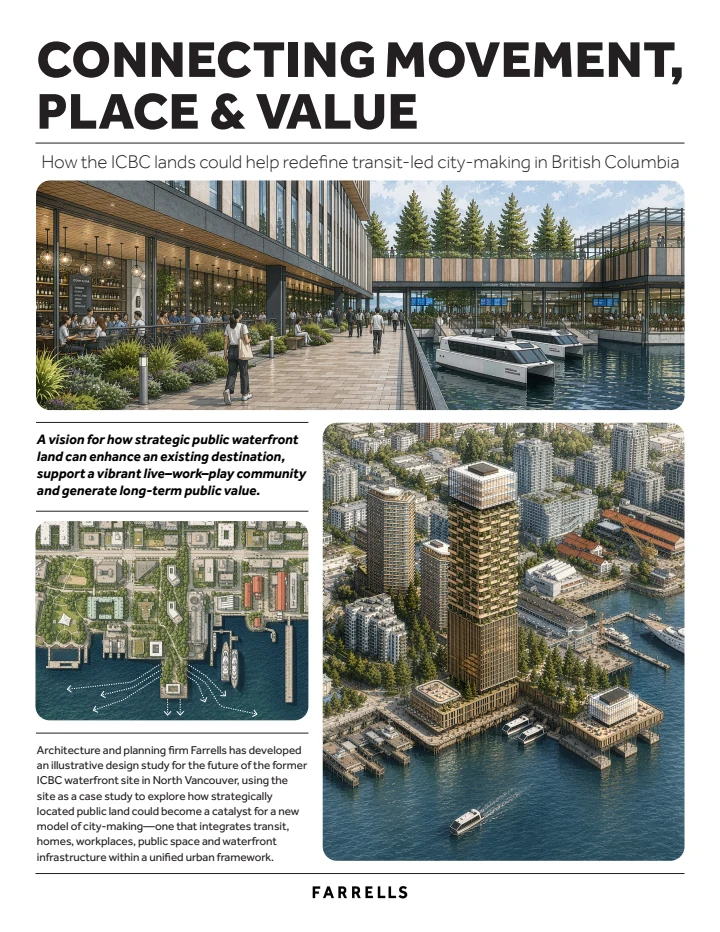
Connecting Movement, Place & Value
How the ICBC lands could help redefine transit-led city-making in British Columbia
A vision for how strategic public waterfront land can enhance an existing destination, support a vibrant live–work–play community and generate long-term public value.
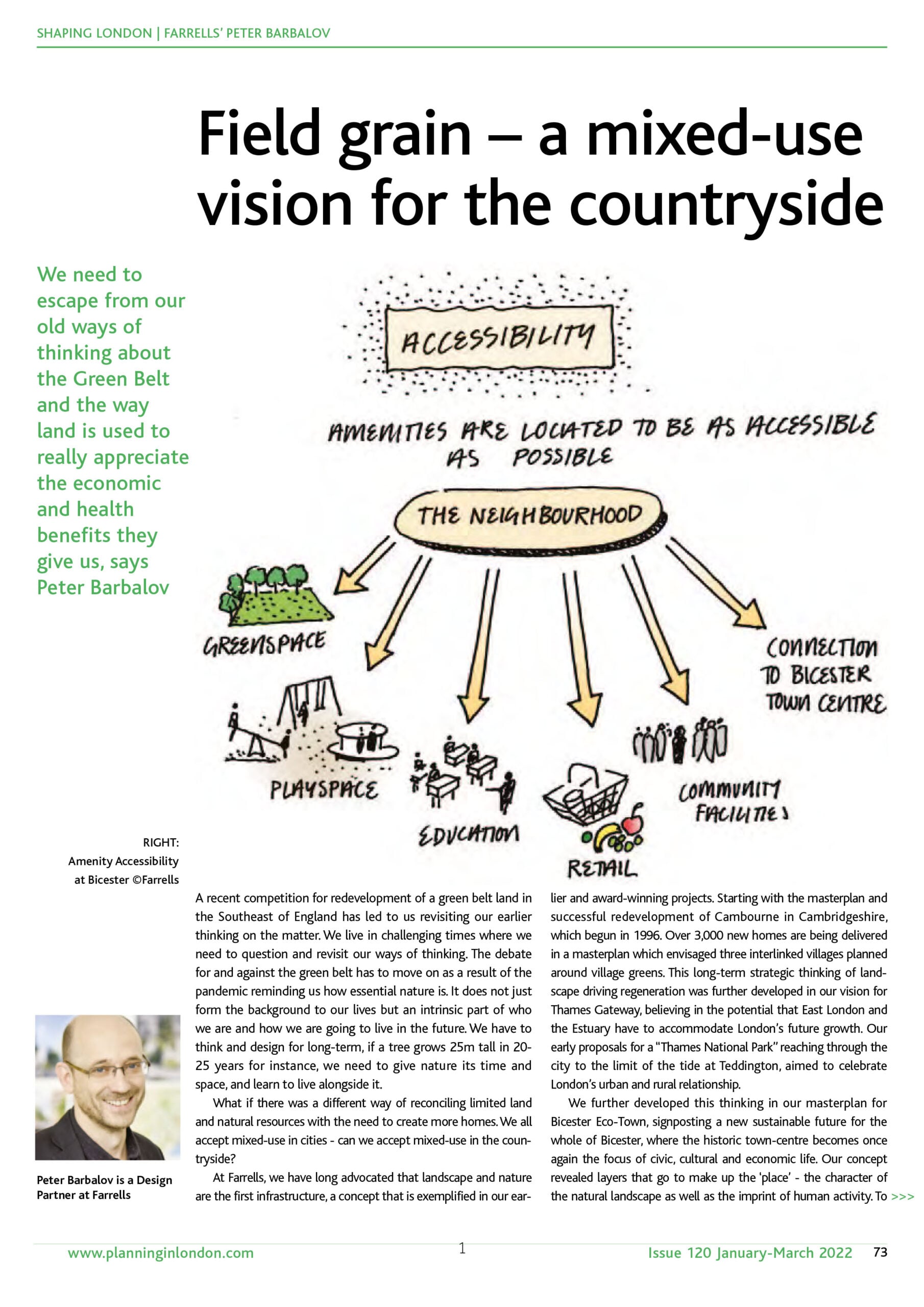
Read PDF ↗Field Grain – A mixed use vision.
Written by Farrells London
January 2022 A recent competition for redevelopment of a green belt land in the Southeast of England has led to us revisiting our earlier thinking on the matter. We live in challenging times where we need to question and revisit our ways of thinking. The debate for and against the green belt has to move on as a result of the pandemic reminding us how essential nature is. It does not just form the background to our lives but an intrinsic part of who we are and how we are going to live in the future. We have to think and design for long-term, if a tree grows 25m tall in 20- 25 years for instance, we need to…
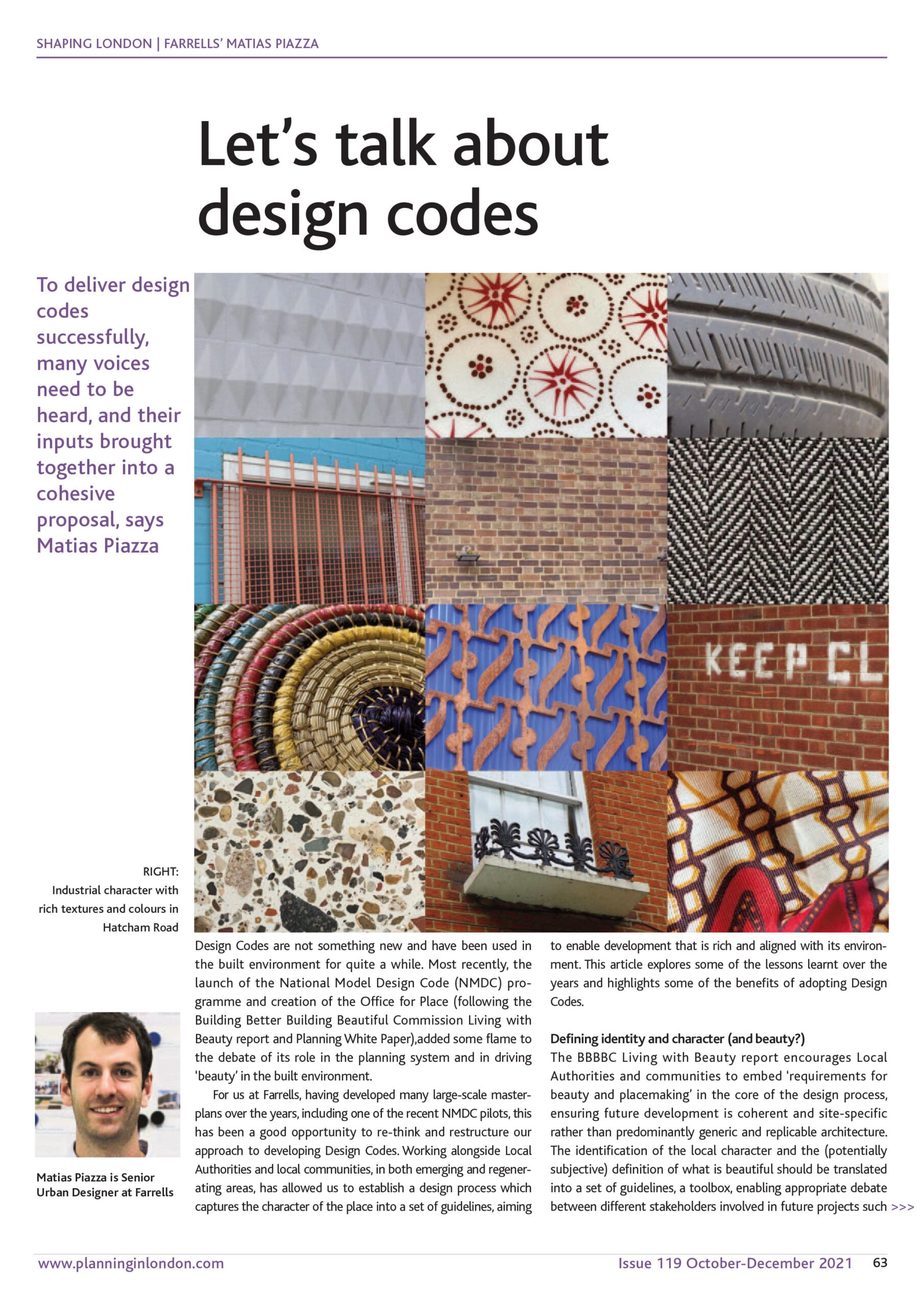
Read PDF ↗Design Codes
Written by Farrells London
Design Codes are not something new and have been used in the built environment for quite a while. Most recently, the launch of the National Model Design Code (NMDC) programme and creation of the Office for Place (following the Building Better Building Beautiful Commission Living with Beauty report and Planning White Paper),added some flame to the debate of its role in the planning system and in driving ‘beauty’ in the built environment.
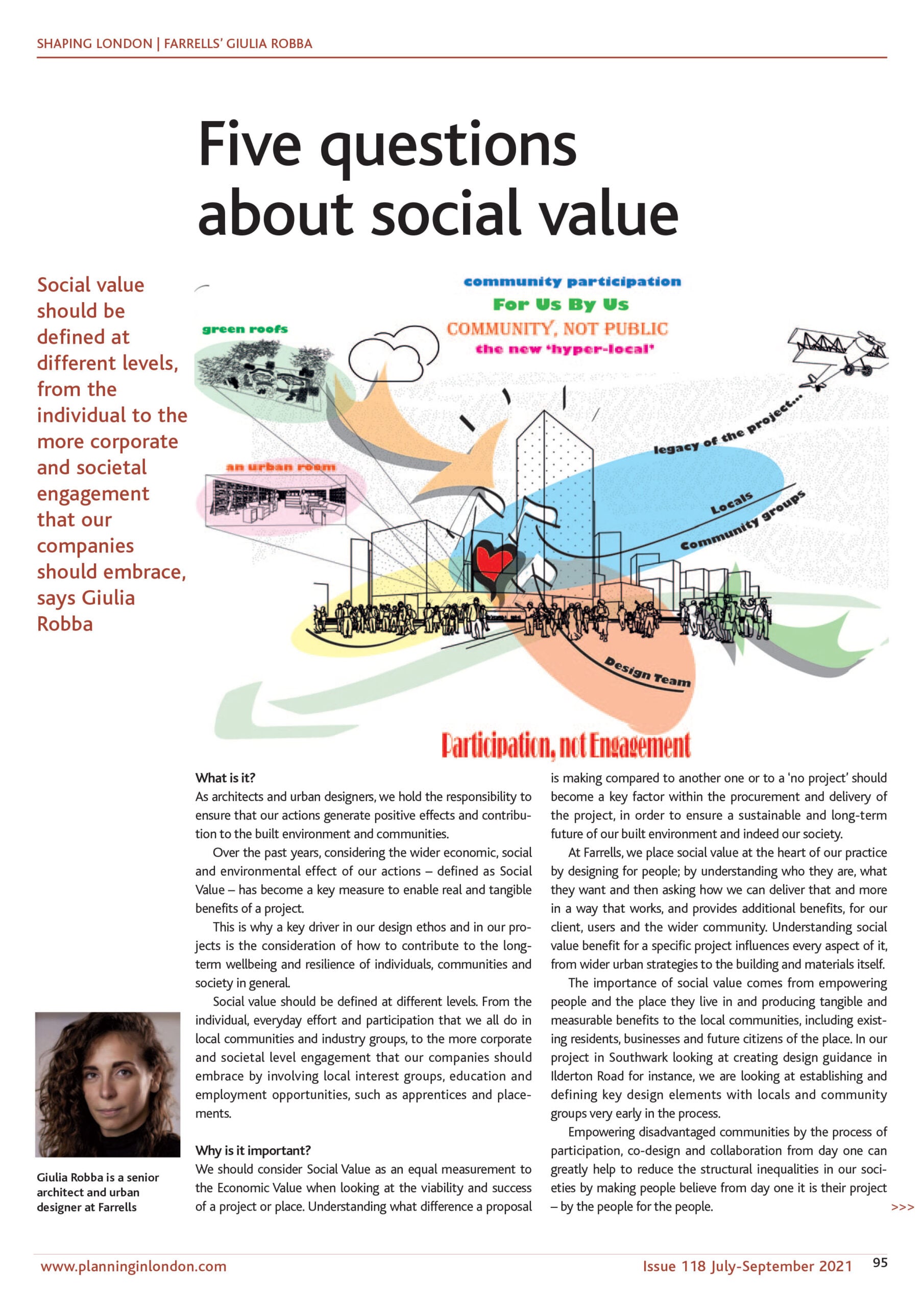
Read PDF ↗Social Value
Written by Farrells London
As architects and urban designers, we hold the responsibility to ensure that our actions generate positive effects and contribution to the built environment and communities. Over the past years, considering the wider economic, social and environmental effect of our actions – defined as Social Value – has become a key measure to enable real and tangible benefits of a project. This is why a key driver in our design ethos and in our projects is the consideration of how to contribute to the long-term wellbeing and resilience of individuals, communities and society in general.
Read PDF ↗Sustainbility Mobility
Written by Farrells London
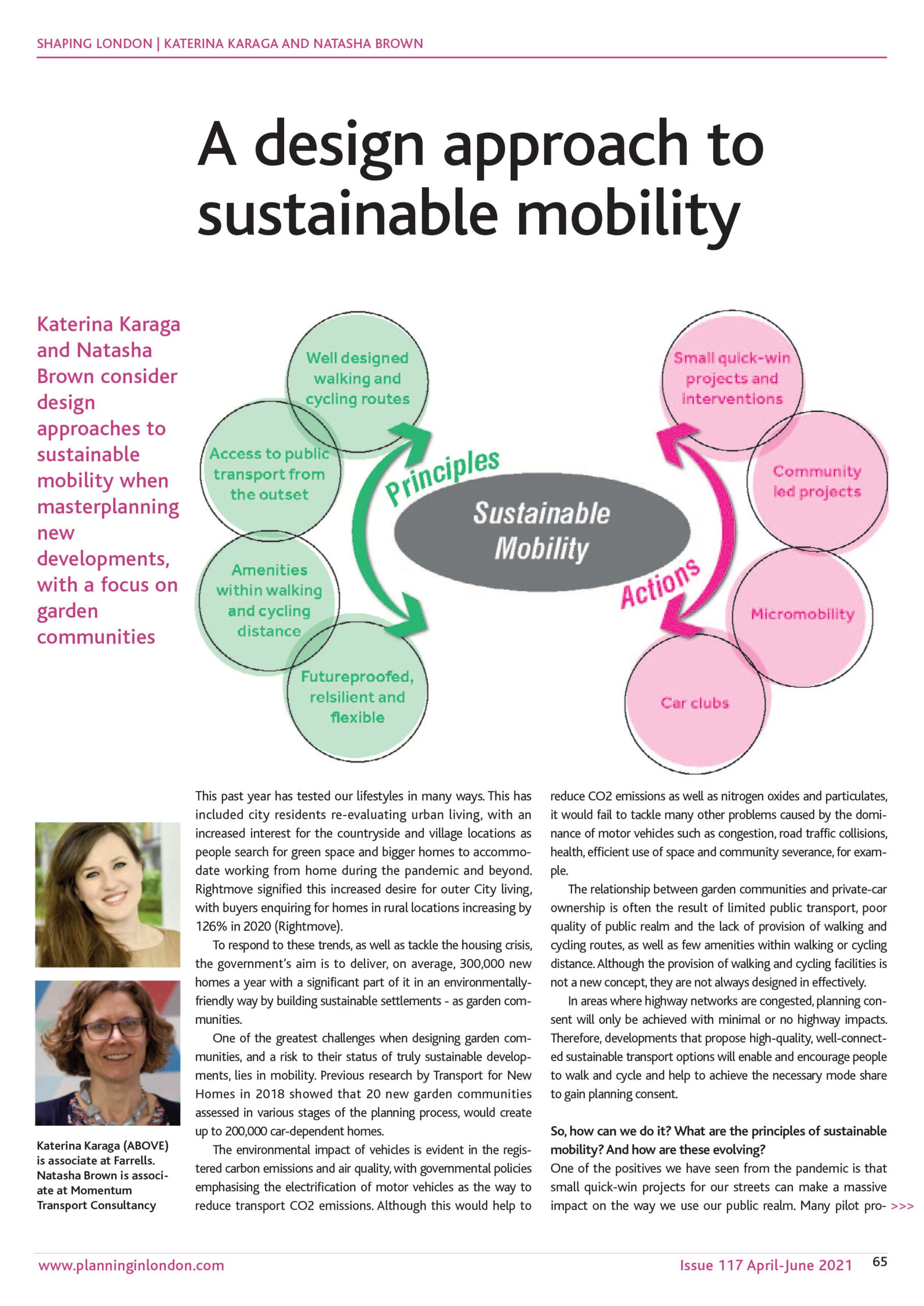
April 2021 This past year has tested our lifestyles in many ways. This has included city residents re-evaluating urban living, with an increased interest for the countryside and village locations as people search for green space and bigger homes to accommodate working from home during the pandemic and beyond. Rightmove signified this increased desire for outer City living, with buyers enquiring for homes in rural locations increasing by 126% in 2020 (Rightmove).
Read PDF ↗Boosting amenity provision in London
Written by Russ Hamilton for Planning in London
February 2020 Our population is booming and London is changing as a result, but change is only good if it means more affordable homes and better social and cultural infrastructure to support new development coming forward. The new London Plan addresses this change and looks at how we can densify our city appropriately without compromising the standard of living.
Read PDF ↗A Modular Masterplan
Written by Farrells London
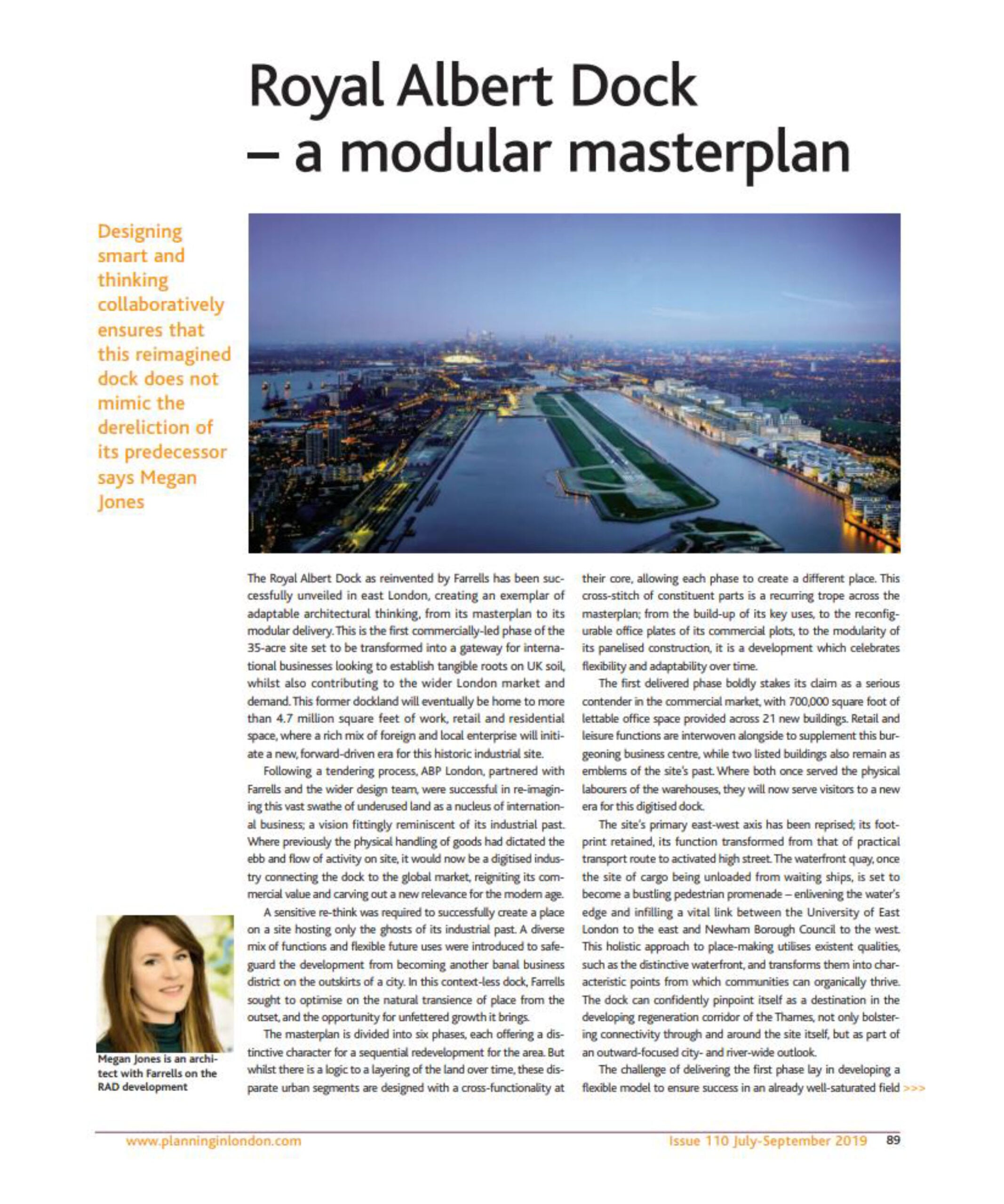
The Royal Albert Dock as reinvented by Farrells has been successfully unveiled in East London, creating an exemplar of adaptable architectural thinking, from its masterplan to its modular delivery. This is the first commercially led phase of the 35 acre site set to be transformed into a gateway for international businesses looking to establish tangible roots on UK soil.
Read PDF ↗The high street has to evolve or die
Planning in London January 2019
Against a background of accelerating change, Farrells work with the GLA on 21st Century High Streets, across London, and most recently with London Borough of Sutton on Sutton High Street, has demonstrated the pressing need to re-consider the role of our High Streets. At a time of significant and rapid change high streets need to adapt and change with the chang-ing world about them. The internet, smart city technologies and autonomous vehicles have and will dramatically change the way we live. Similar to many high streets across London, the course of our work in Sutton saw Toys R Us, Maplin and PoundWorld…
Read PDF ↗The Streets We Choose
Planning in London July 2018
Two years ago, here at Farrells we began to explore the likely impacts of the autonomous vehicles on our future streets and places (PiL issue 98, July-September 2016). With advances in knowledge and predictions, we provide an update on how our own analysis and thinking has moved on. We recently demonstrated our vision of how we can ‘Reclaim the Streets’ in our entry for an international competition organised by World Architecture News, and we were delighted to be the only UK participant in a global shortlist of 12 with a strong concept. Our multi-ethnic team of urban designers and architects: Neil Bennett,…
Read PDF ↗Creating quality – Garden Cities
Planning in London April 2018
Settlements have been evolving for at least 6000 years if not longer, but we seem to have learned very little about making good ones. The present crop is so focused on housing that places for the cultural diversity of contented citizens seem long forgotten. Civilised Quality New Settlements are Places to Live, Work and Enjoy, rather than merely be beautiful places to visit. They must not be the husks of half-forgotten rules and codes but the spirit that embodies them. True and quality placemaking responds to underlying spatial significance e.g. history, topography, environment, connections, convenience and…
Read PDF ↗Making best use of London’s industrial land
Planning in London April 2018
The pressure on London’s housing, workplaces, leisure and services is evident. We have all heard the latest numbers for London’s growth: increasing population of 10.8 million by 2041, i.e. +20 percent – with a demand for 19,000 new jobs and 66,000 additional homes to be created every year, all in a constrained and limited land area. In dynamic cities such as London, change is imminent. The clear practical distinction between uses; residential, industrial and entertainment, is slowly disappearing. London could drastically change in the future; live, work and play could be further blurred. So, what is the new…
Read PDF ↗A Life in Planning
Planning in London October 2017
“These are exciting times to be a planner. City making is the biggest business of the 21st Century across the globe and urban planning has a critical role to play. There is a huge demand for the very particular skill sets required, and in particular for creative, collaborative and proactive planning led by visionary people who want to make things happen. In my view we are not yet rising to the challenge.”
Read PDF ↗24-hour Cities
Planning in London July 2017
What if we imagined a flexible, moving market, where stalls might sell croissants in the morning and mojitos at night? This was the initial premise of the entry Farrells submitted, just over two months ago, in response to the Built Environment Trust’s call for ideas to make cities work as 24-hour places to live. It turned out that what we imagined would be a fun opportunity to engage in out-of-the-box thinking was much more successful than we had anticipated. In fact, when we learned that our project had been selected as the winning entry, the team’s screams of joy could be heard from one end of Hatton…
Read PDF ↗Post-Modernism Post-Brexit
Planning in London April 2017
Many have questioned the future of the architectural profession following Brexit but very few have enquired about the direction architecture itself might take in a post-Brexit scenario. Sir Terry and Giuseppe Parita discuss.
Read PDF ↗Ten Propositions for Planning in London
Planning in London April 2017
In January 2017, Max Farrell was invited to present to the All Party Parliamentary Group for London’s Planning and the Built Environment in Parliament, organised by the London Society and chaired by the MP Rupa Huq. Here’s what he said to them…
Read PDF ↗The Future of Workspace
Planning in London January 2017
The most successful commercial buildings are those that consider the ever-changing nature of the workplace from the outset says Farrells Partner Peter Barbalov.
Read PDF ↗Sir Terry Farrell’s Banister Fletcher lecture
Planning in London January 2017
A transcription of Sir Terry’s 2016 London Society Banister Fletcher Lecture.
Read PDF ↗Transport oriented development – the key to sustainable urbanism
Planning in London October 2016
We should look long and hard at all the opportunities to intensify development around transport hubs to create more homes as well as easier access to jobs, services and green spaces says Farrells Managing Partner Laura Mazzeo.
Read PDF ↗Autonomous vehicles and future placemaking
Planning in London July 2016
Connectivity between rural areas and urban centres would be transformed by autonomous vehicles says Nigel Bidwell.
Read PDF ↗Shortening the food chain
Planning in London April 2016
We must design for planned urban agriculture and urban infrastructure which encompasses green technology with food and closed-loop waste-biased city living, say Terry and Bee Farrell.
Read PDF ↗As we move towards a denser London, is it time to rethink the rules?
Planning in London January 2016
It may seem ironic that in looking for ideas for the future, we are starting with the solutions of the past says Sir Farrell – a discussion piece on the issues facing us as we move towards a denser London.
Read PDF ↗Bridging East London
Planning in London October 2015
There are 34 bridges across the Thames but only one to the East of Tower Bridge – Sir Terry discusses the need to unlock housing capacity with low-level river crossings.
Read PDF ↗London’s Future
Planning in London July 2015
Growth is happening – it is something we can’t avoid. But we can plan for it, and with long term, proactive planning, we can turn the issue of growth into an opportunity for placemaking says Farrells Partner Nigel Bidwell.
Read PDF ↗Starter homes: design moves up the agenda
Planning in London April 2015
The constant challenge for the design profession is to meet demands and retain relevance in a changing economic, environmental and cultural landscape says Farrells Partner Gary Young.
Read PDF ↗Trees in the Urban Landscape
Planning in London April 2014
“Trees simply make our towns and cities a better place to be, as well as bringing health, food, oxygen, fuel, environmental and climatic benefits as well as sustenance and habitats for other species.”
Read PDF ↗Farrells Focus – Nam Tong
Farrells Hong Kong
Hong Kong is growing and land supply is a pressing concern. How we grow is integral to ensuring the city’s continuing liveability, sustainability, and competitiveness. The future presents uncertainties and the precise nature and extent of long-term urban growth can never be fully predicted. We believe in a flexible, incremental growth strategy that works to enhance the existing urban context and builds on existing plans. Nam Tong is a conceptual new town for 500,000 residents at the eastern edge of the urban area.
Read PDF ↗The Instant City
Farrells Focus
An article looking at rapid urban expansion and ‘instant cities’ with a focus on Farrells One Excellence project in Shenzhen, China
Read PDF ↗No matches found. Try a different title.